AI isn't killing recruitment. Recruitment might be doing that itself
Executive-search practices are being sold as innovation in 2026. I was doing them in 2012 with Excel and LinkedIn Recruiter. Recruitment doesn't have an innovation problem. It has a standards, leadership and accountability problem, and 13 practical ways to fix it.
Why are we celebrating recruitment practices from 2015 as innovation in 2026?
There's been a lot of conversation about treating every hire like an executive hire and it only made me say "duh!"
Lenny's conversation with Adam Ward, former Head of Talent Acquisition at Cursor, is one example. It generated interest in the idea of bringing executive-search practices into everyday recruitment.
I listened to it, and while I appreciated parts of the conversation, I struggled to understand what was supposed to be revolutionary.
Yes, there were examples of substantial investment in recruitment. And yes, some of the approaches were well executed. But much of what was discussed came down to common sense, empathy, resources and established recruitment practices.
Market mapping. Building relationships with candidates. Understanding hiring managers. Preparing people for interviews. Selling opportunities properly. Thinking beyond the vacancy we're trying to fill today.
I was doing these things in 2012, 2015 and 2016. With an ATS, LinkedIn Recruiter, Excel, PowerPoint and whatever else was available back then (which was a fraction of what we have today)
No AI. No sophisticated automation. No enormous technology budgets.
And I wasn't alone. These were established recruitment practices, at least in the environments where I worked.
Yet here we are in 2026, discussing them as though someone has invented a new profession.
I don't think recruitment has an innovation problem. I think we have a problem with professional standards, leadership and accountability.
And before anyone gets defensive, I'm including TA leaders, recruiters, hiring managers and organisations in this.
1. Your hiring manager wants a unicorn 🦄. So what?
One of the most common complaints I hear from recruiters in the Talent Crunch community is that hiring managers have unrealistic expectations.
"They want someone with ten years of experience in a technology which has existed for three."
"They want exceptional technical skills, leadership experience, industry expertise and a salary below market."
And?
We are the talent acquisition professionals. Our job is to challenge those expectations.
If we know which role we're going to discuss in a kick-off meeting, are we arriving without understanding the market? Have we researched the available talent, relevant competitors, salary expectations and potential hiring challenges?
Are we asking questions about the existing team?
Who is already there? What skills do they have? Where are the gaps? Who is developing towards a promotion? Is another senior hire even necessary?
If a manager wants to hire the 4th senior engineer into a team of 6, shouldn't someone (we) question the team composition?
Perhaps the team needs someone more junior. Perhaps it needs a different skill set. Perhaps the existing team has capabilities nobody has properly assessed. Perhaps the position shouldn't exist in its proposed form.
Our job isn't to accept a job description and start searching. It's to understand the business problem behind the request and help determine the best hiring response.
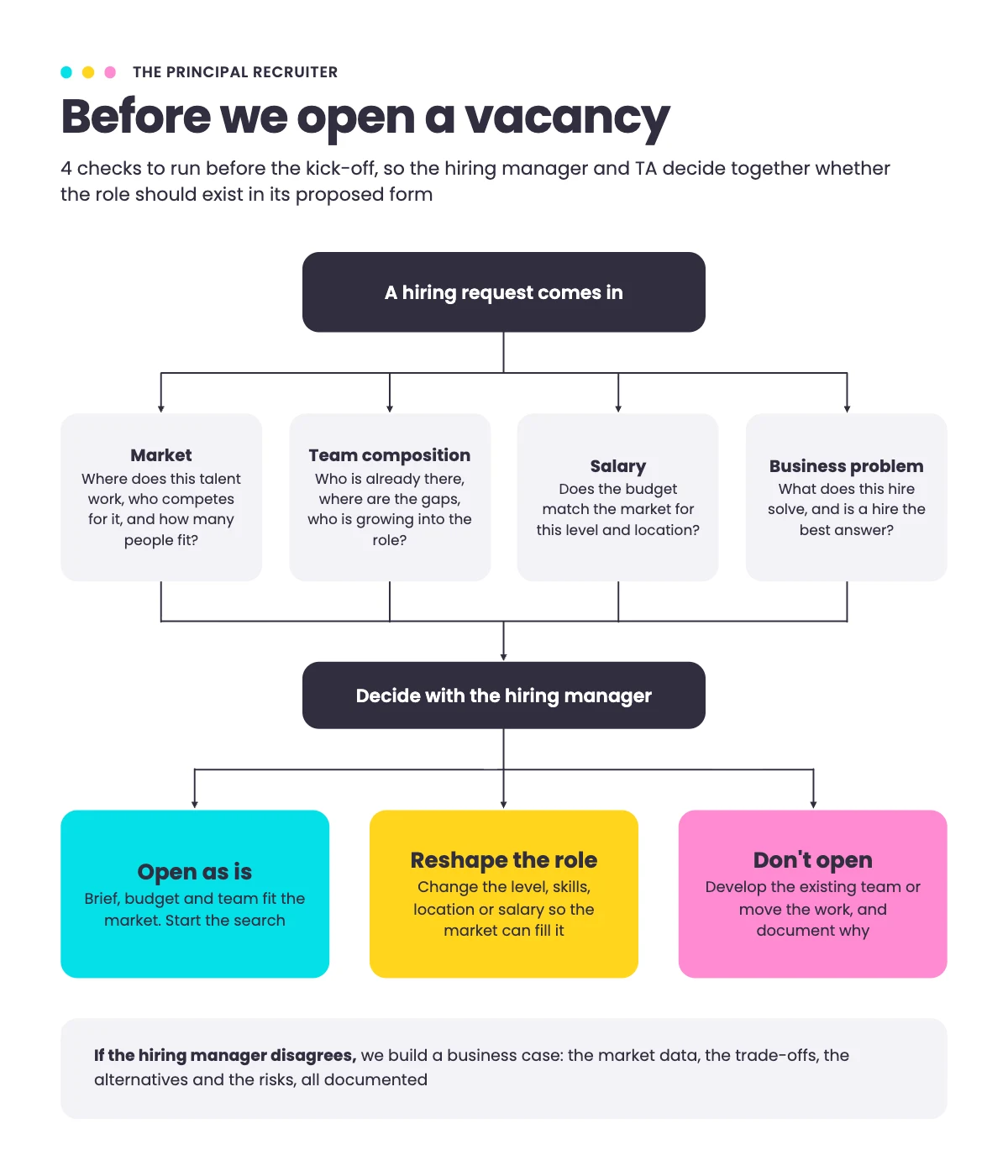
And if the hiring manager refuses to listen?
Build a business case. Show them the market. Explain the trade-offs. Present alternatives. Document the risks.
We won't win every argument. But at least have the argument.
2. Market mapping isn't an executive search privilege
People talk about executive search as though it operates according to some mysterious set of principles unavailable to ordinary recruiters.
Market mapping. Relationship building. Long-term candidate engagement. Talent intelligence.
Why should these practices be reserved for executives?
At Zalando, back in 2015, I was building market maps for entire job categories.
I wanted to understand which companies employed the people we needed, where those people worked, what their backgrounds looked like and which individuals were worth getting to know.
I built candidate pools and kept notes about people's strengths, interests and potential fit for future opportunities. If someone wasn't suitable for the vacancy I was working on, I considered whether another team might benefit from their experience.
If the timing wasn't right, I maintained the relationship. I rarely wanted to start a search from scratch.
Why would I?
I'd already invested time understanding the market and meeting people. That knowledge didn't suddenly become worthless because one vacancy closed.
And this wasn't some extraordinary initiative. It was basic recruitment in my opinion
3. Recruitment is a relationship business. When did we forget?
I used to meet candidates for coffee ☕️. Sometimes during lunch, sometimes after working hours, sometimes simply because I wanted to understand someone better.
There wasn't always an immediate vacancy or outcome. But I learned what motivated people, what frustrated them, what they wanted from their careers and what circumstances might make a move attractive.
Sometimes the first opportunity wasn't right. The 2nd or 3rd one was.
Today, we have video calls, scheduling tools, automated follow-ups and countless ways to stay connected. Yet we still behave as though every candidate conversation needs to produce an immediate result.
Even worse, look at what happens when a recruiter approaches a passive candidate.
We contact someone because we think they might be interested in an opportunity. They agree to speak with us. And then we spend the entire call interviewing them.
Sorry, what? We approached them.
Shouldn't our first responsibility be to explain why the opportunity deserves their attention?
Understand what they want. Explain the role. Discuss the team. Answer their questions. Give them enough information to make an informed decision.
Of course we need to assess suitability. But perhaps that deserves another conversation. Or perhaps the first conversation needs to be longer.
Why are we so obsessed with compressing every interaction into the shortest possible time? A shorter process isn't automatically an overall better process.
4. Why are candidates still expected to figure everything out themselves?
In 2012, when I was working in agency recruitment, I created information packs for candidates. For every client. In 2012!
I explained the company, the opportunity, the interview process and how candidates should prepare.
Later, I developed more detailed candidate materials covering teams, hiring managers, expectations, challenges and other opportunities within the organisation.
Why? Because candidates deserve information. Because prepared candidates have better conversations. And because someone who isn't interested might know another person who is.
At Zalando, I developed an offer package which was adopted across the company. It wasn't a generic email with a PDF attachment. It was a proper presentation of the opportunity and the organisation.
Something which reflected the effort we expected candidates to invest in us.
Today, we have even more possibilities.
We might build an interactive offer experience explaining compensation, equity and benefits, including an equity calculator to help candidates understand different scenarios.
We might show the product, introduce the team, explain its ambitions and describe potential career paths. We might create a simple website for each major hiring initiative.
Or we might use Google Slides.
The point isn't the technology. It's the willingness to think about what information someone needs and then make it available.
At an event I attended recently, I heard an example which I appreciated.
A founder explained that he'd recorded a 20-minute video introducing the company and explaining what it does. Candidates received it before their interviews. Hiring managers also recorded shorter videos explaining their teams, what they worked on and what they were planning for the future.
Candidates received these before meeting the hiring manager.
Brilliant. But why is this still unusual? Why aren't more companies doing something similar?
5. Interview preparation is part of your job
We talk endlessly about candidate experience. Then we send candidates into interviews with little understanding of what to expect, or allow interviewers to walk into conversations without knowing what they're supposed to assess.
Both are unacceptable.
Prepare your candidates. Explain the interview structure, the competencies being assessed and what good evidence looks like. If someone struggles to communicate their experience clearly, help them understand how to structure their answers.
I'm not suggesting teaching candidates to invent achievements or manipulate an assessment. I'm talking about helping people communicate their actual experience.
And prepare your interviewers.
Train them to ask relevant questions. Review their feedback. Challenge vague assessments.
If an interviewer writes that someone wasn't a good fit, ask what it means. What evidence supports the conclusion? Was the candidate assessed against the agreed criteria? Did the interviewer even ask the questions they were supposed to ask?
Hiring managers have responsibilities here too. They should understand how their teams represent the organisation and whether interview feedback supports the hiring decision.
Recruiters shouldn't be passive administrators collecting scorecards. They should help maintain the quality of the assessment process.
6. Stop confusing activity with performance (productivity)
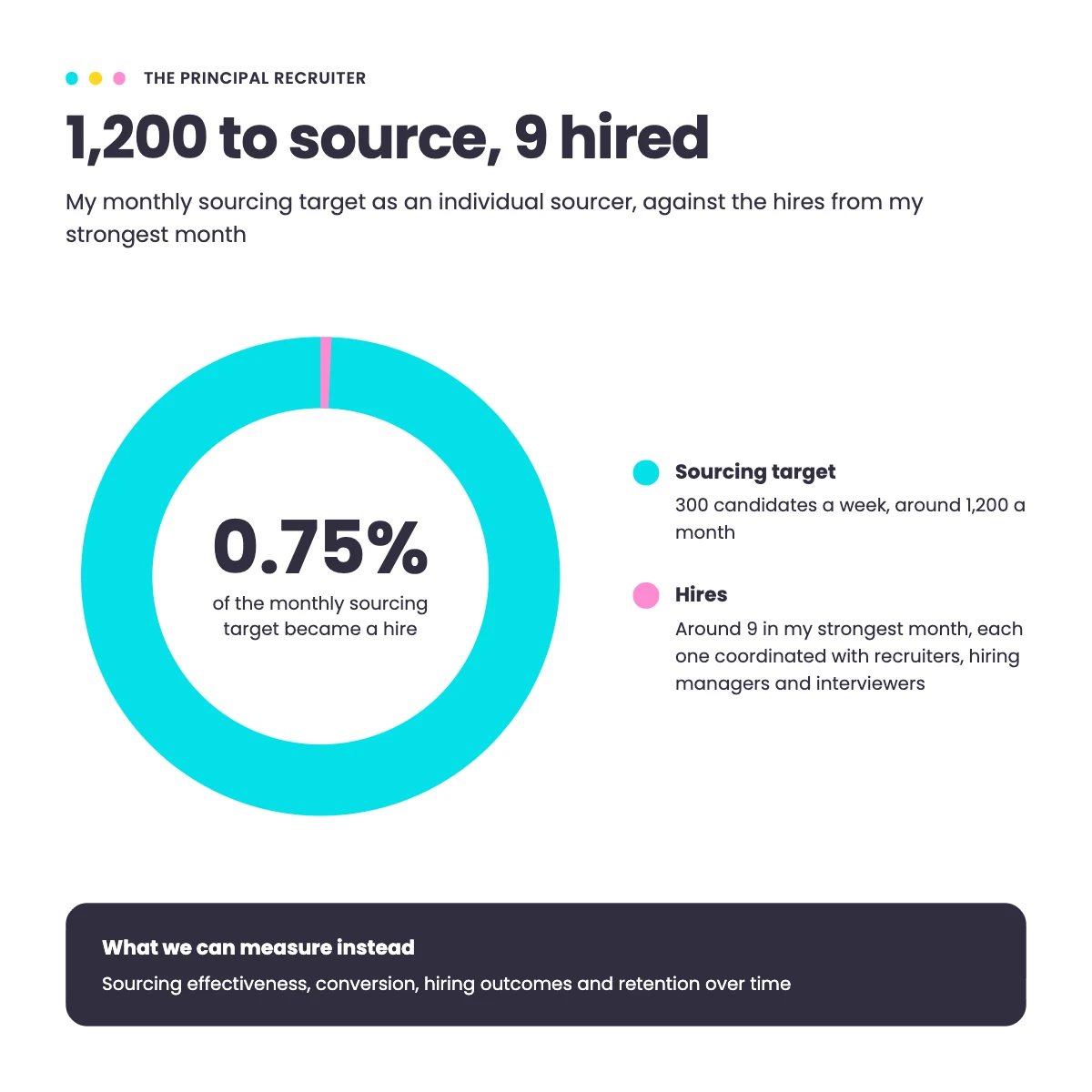
At one point in my career, I had a KPI of sourcing 300 candidates per week.
Three hundred. It was ridiculous.
I rarely achieved it. But I delivered hires.
My strongest month was around nine hires as an individual sourcer. And those hires required coordinating recruiters, hiring managers, interviewers and everyone else involved.
I understood something which seems to get lost in recruitment performance conversations.
Activity is not the same as impact.
We might conduct 20 interviews a day. Wonderful. What happened afterwards?
We might reduce the time to hire to 20 days. Congratulations. What happens when those employees leave after six months?
What did the business gain?
I'm not against KPIs. I'm against KPIs which reward the wrong behaviour.
Measure sourcing effectiveness, conversion and hiring outcomes. Understand retention. Examine candidate experience and hiring quality.
And look at performance over time.
Recruitment activity compounds. The relationships we build today might produce hires next month or next year. The candidate who declines today might become our strongest hire in six months. The market map we build today might support several future vacancies.
If our performance framework only rewards immediate activity, don't be surprised when recruiters stop investing in longer-term work.
7. You have 25 vacancies? Start thinking strategically.
I keep hearing recruiters explain that they don't have time to work strategically because they have too many vacancies.
I've been there.
When I joined Wayfair, I was brought in to help build the technology leadership structures across the European organisation. I was responsible for approximately 22 to 25 senior leadership vacancies, including positions for entirely new departments, from day one.
That was my job. Leadership hiring across technology. I know what a demanding workload looks like. And no, I don't believe people should work 25 hours a day.
But having 25 vacancies doesn't mean you should treat all 25 equally.
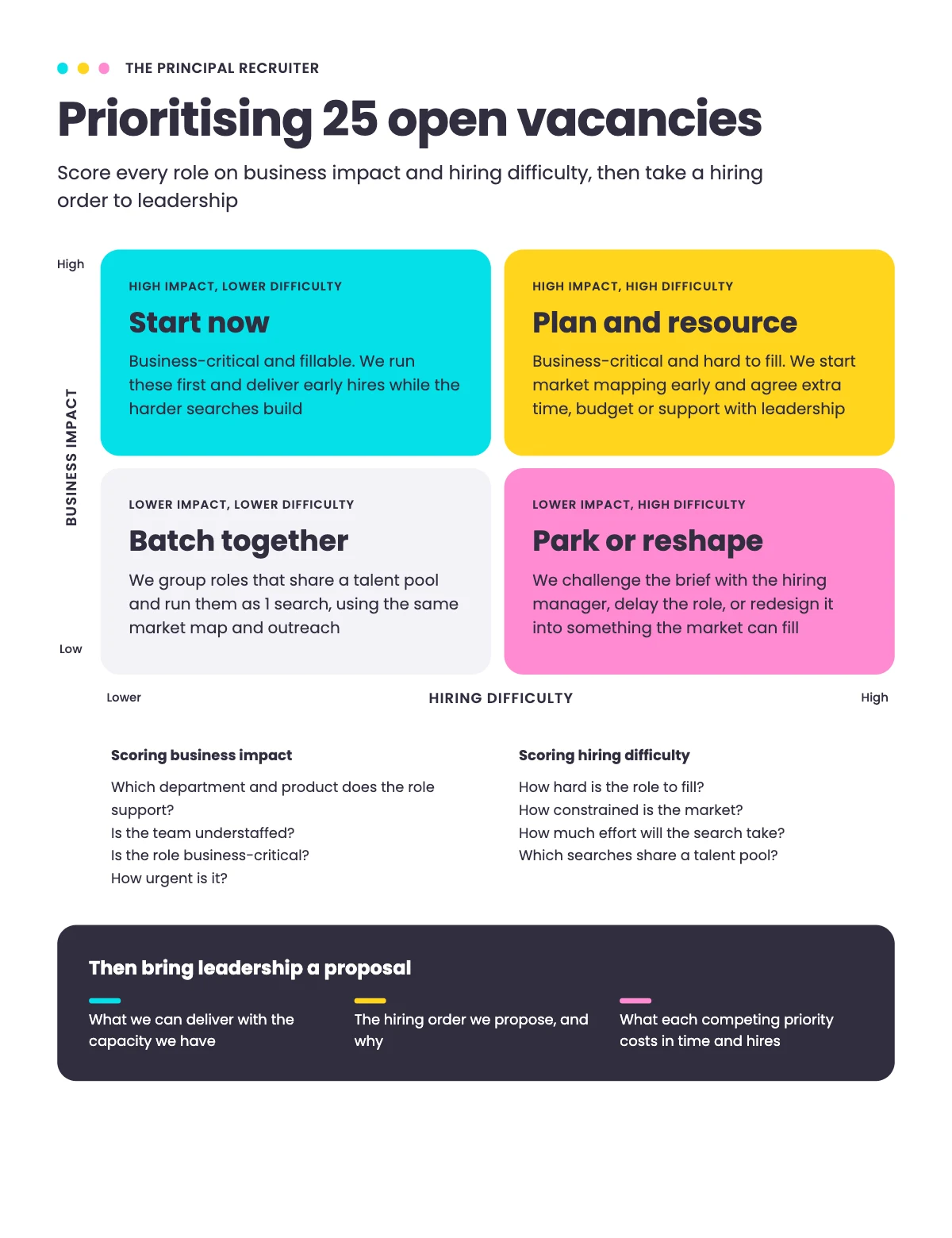
Start by mapping them.
Which departments do they belong to?
Which products or business priorities do those departments support?
Which teams are understaffed?
Which vacancies are business-critical?
Which positions are particularly difficult to fill?
Where is the market most constrained?
What is the expected hiring effort?
Which searches share overlapping talent pools?
Give those vacancies a priority based on business impact, urgency and hiring complexity.
Then take your analysis to leadership. Explain what is achievable with the available capacity, propose a hiring order and show the consequences of competing priorities.
If you don't have the authority to make those decisions, ask your leadership to support you. But bring them a proposal. Don't sit there waiting for someone else to solve the problem.
Being proactive doesn't mean accepting an unreasonable workload. It means using evidence to challenge it.
8. Your employees already know people you want to hire
How many recruitment teams have properly explored their employees' professional networks?
How many have organised sourcing sessions with engineers, product managers, designers or other specialists?
We used to organise searchathons.
Get people together. Understand who they know. Identify professionals they'd like to work with. Build a list of potential candidates and develop an appropriate approach.
The same applies to referrals.
If we want hiring managers to advertise vacancies on LinkedIn, we have to help them. Write a first draft and ask them to adapt it to their own voice.
If we want employees to participate in a referral programme, we need to explain the opportunities. Create material for Slack. Ask leadership to communicate the initiative. Follow up. Make participation easy.
Why do we expect hiring managers and employees to spontaneously become recruitment advocates without helping them?
Do we want their involvement? We must lead the effort.
9. Offer negotiation starts with the first conversation
Why are we waiting until the end of a hiring process to understand whether someone's expectations align with the opportunity?
Compensation should be discussed early.
Candidates deserve clarity about salary ranges, benefits and the structure of an offer. And recruiters need to understand the market well enough to challenge unrealistic compensation budgets. Thank God for the Pay Transparency Directive, I really hope that this has helped improve things a bit.
If the salary is below market, explain the implications.
Perhaps the search will take longer. Perhaps the company needs to consider candidates from different locations. Perhaps relocation support becomes necessary. Perhaps the required experience needs to change.
Present the options, explain the risks and negotiate internally before you reach the final candidate negotiation. Don't spend weeks moving someone through interviews only to find out that the company cannot meet expectations which were clear from the beginning.
That's preventable.
10. Recruitment doesn't end when someone signs an offer
I used to check in with people after they joined.
I wanted to know how they were doing, whether the reality matched what we'd discussed, whether they were settling into the team and whether something wasn't working.
Because hiring isn't simply about filling a vacancy.
It's about bringing someone into an organisation where they have a reasonable opportunity to succeed.
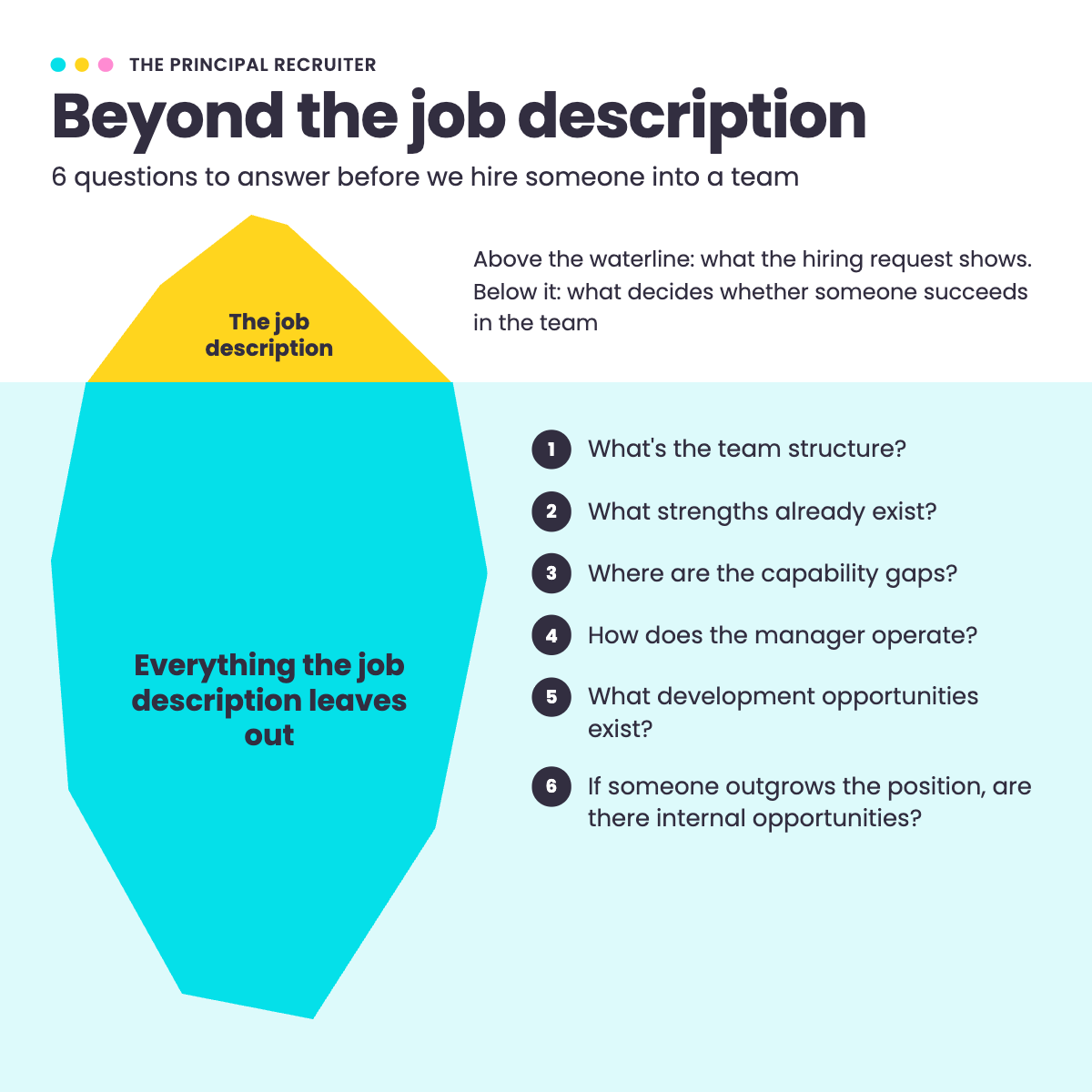
And that requires understanding more than the job description.
What's the team structure?
What strengths already exist?
Where are the capability gaps?
How does the manager operate?
What development opportunities exist?
If someone outgrows the position, are there internal opportunities?
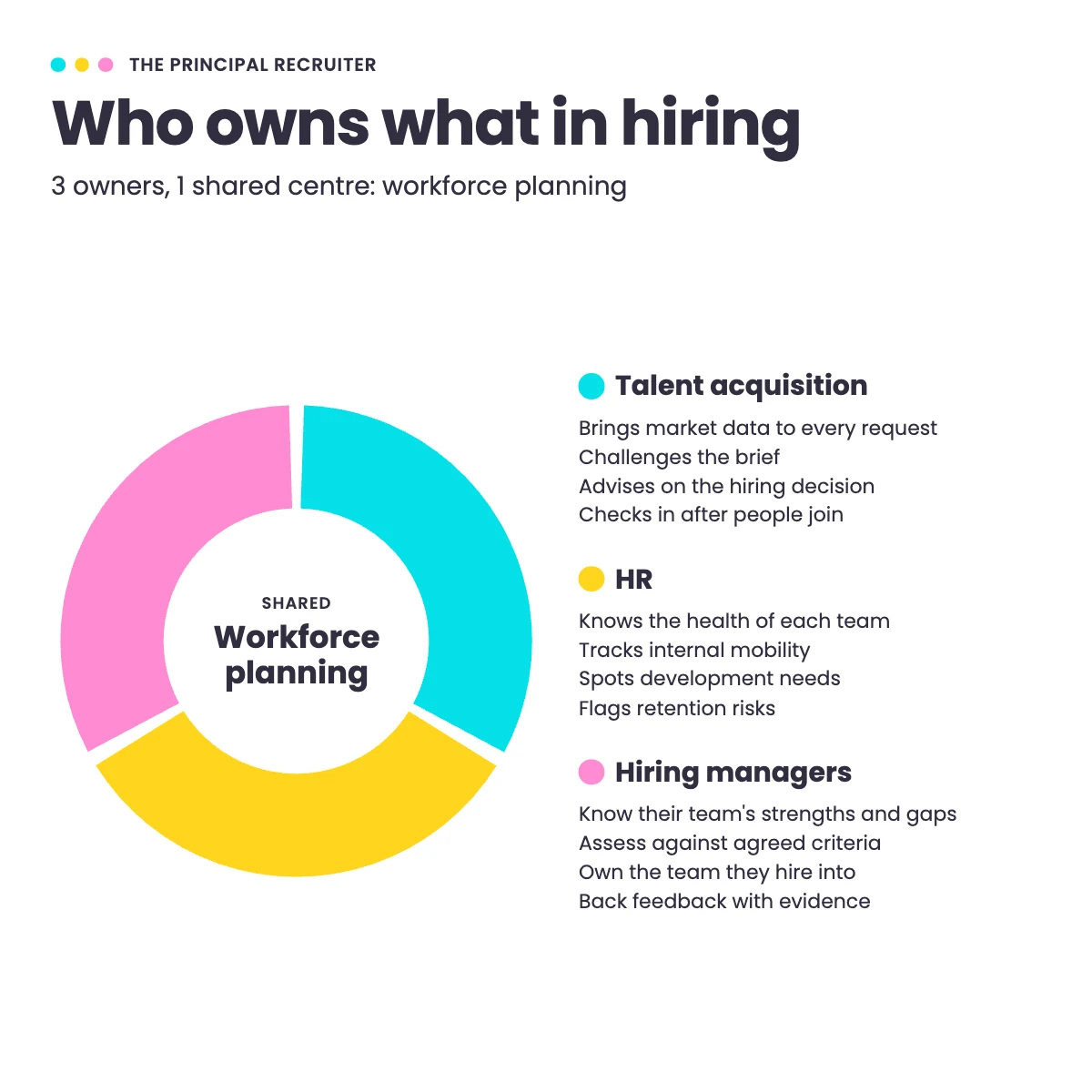
This is where talent acquisition, HR and hiring managers need to work together.
HR should understand team health, internal mobility, development needs and potential retention risks.
Hiring managers should understand their teams, assess candidates properly and take responsibility for the environment they're hiring people into.
Talent acquisition should use this information to advise on hiring decisions.
These aren't separate conversations. They're connected parts of workforce planning.
11. The problem starts at the top
I believe a significant share of the responsibility for the state of recruitment sits with TA leadership.
Somewhere along the way, we started confusing management seniority with professional expertise.
Someone becomes a Head of Talent Acquisition, Director or VP. They spend their days in leadership meetings, discussing budgets, headcount, reporting and organisational politics. And somehow their title becomes evidence that they understand what excellent recruitment looks like today.
It doesn't. And it’s not their fault (entirely), it’s how organisations are often setup, across most departments, TA is just one of them.
Being responsible for a recruitment function doesn't automatically make someone an excellent recruitment practitioner. And managing people doesn't automatically mean knowing how to develop them.
I've been talking about the importance of senior individual contributors for years.
As a Principal Talent Acquisition Partner, I saw the value of having experienced practitioners who understood the work deeply, operated strategically and influenced the organisation without needing to manage a team.
Now people like Elena Verna at Lovable are bringing greater attention to senior IC careers, and I'm VERY glad, cause now people listen.
Because organisations need people who are exceptionally good at the work itself.People who understand today's market. People who know how to build recruitment strategies, influence stakeholders, develop processes and coach others.
People who are close enough to the work to understand where it breaks.
Not every expert needs to become a manager. And not every manager is an expert.
If you're leading a TA team, your responsibility goes beyond distributing vacancies and reviewing dashboards.
You need to develop your people. Teach them how to conduct market research, challenge hiring requirements and build business cases. Encourage mentoring and create opportunities for them to learn from experienced practitioners.
Reward initiative and sound judgement. And stop measuring their value primarily through activity metrics.
If your team consists of order-takers, you need to ask what you've done to develop advisers.
12. But recruiters aren't off the hook either
Leadership carries significant responsibility. That doesn't mean individual recruiters have none.
At some point, we have to take ownership of our professional development.
Be curious.
Ask questions.
Learn how the business works.
Understand the products our company builds.
Speak to engineers, designers, product managers, practitioners and business leaders. Learn how teams operate. Find out what other recruitment teams are doing, meet people. Experiment with different approaches. Ask for mentoring.
If we encounter a problem repeatedly, we need to stop treating it as an unavoidable inconvenience.
Investigate it.
Think about what causes it. What happens next? Where will the process break? What might prevent the problem? What alternatives exist?
This is what strategic thinking looks like in practice.
It's thinking several steps ahead. And if you have access to AI, you have an extraordinary opportunity to reduce repetitive work.
Map the tasks you perform repeatedly. Identify what deserves automation. Build reusable materials and create systems which preserve information and relationships. But please don't confuse adopting AI with becoming strategic. AI won't compensate for a lack of curiosity, judgement, empathy or ownership. It might simply help you perform the same ineffective process faster.
13. When did we stop expecting more from ourselves?
I remember conversations around 2015, 2016 and 2017 about recruiters becoming strategic advisers.
We talked about influencing hiring managers, understanding business needs and earning a seat at the table.
Then something changed. During and after the pandemic, recruitment teams experienced enormous shifts in demand, staffing and expectations. In many organisations, recruitment became increasingly transactional.
Open the vacancy. Post the job. Screen the applicants. Schedule the interviews. Collect the feedback. Send the offer. Repeat.
And now we have an industry full of people complaining that they aren't treated as strategic partners.
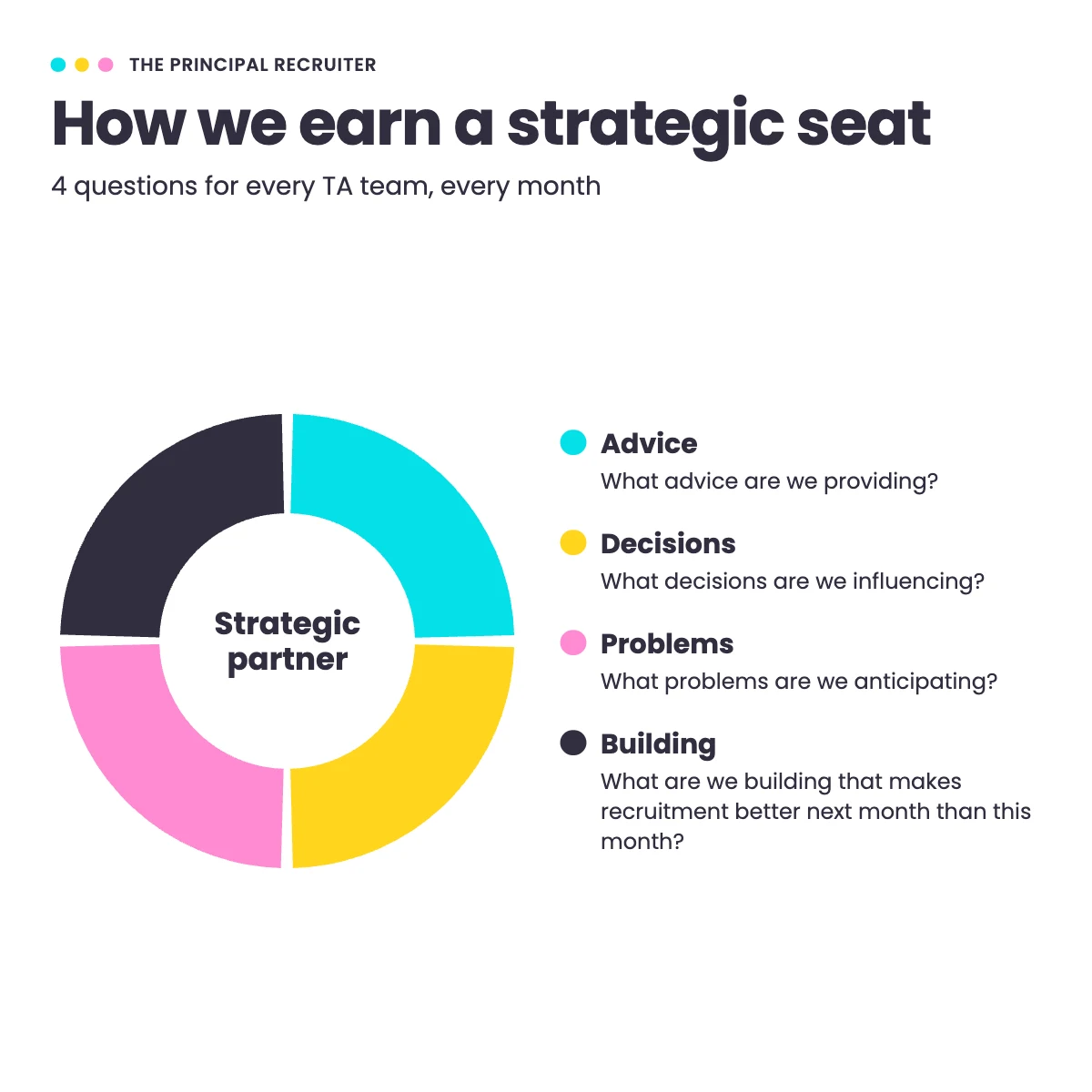
But what are we doing to earn that position?
What advice are we providing?
What decisions are we influencing?
What problems are we anticipating?
What are we building which makes recruitment better next month than it was this month?
And what are TA leaders doing to create an environment where those behaviours are expected, developed and rewarded?
I'm tired of hearing that recruiters don't have the tools. We were doing these things with spreadsheets and presentation software.
I'm tired of hearing that hiring managers are difficult. Influencing hiring managers is part of the profession.
I'm tired of hearing that there isn't enough time. Sometimes there genuinely isn't. That's when prioritisation and a proper business case become even more important.
And I'm tired of seeing basic recruitment practices presented as revolutionary ideas.
Because they aren't.
We have more technology, more data and more access to information than at any point in recruitment history. Yet we're still discussing practices which were established more than a decade ago.
Perhaps the question isn't how AI will transform recruitment.
Perhaps the question is why we haven't mastered the fundamentals we already had.
And perhaps it's time we stopped asking why recruitment isn't respected as a strategic function and started asking whether we're consistently demonstrating the expertise, judgement and accountability which deserve that respect.
Because talent acquisition is far more than processing vacancies.
It's understanding organisations, people, markets and business needs. It's anticipating problems before they become expensive. It's challenging decisions when the evidence doesn't support them.
It's building relationships which outlast individual vacancies. It's taking responsibility for the quality of the work. And it's having the professional courage to do more than simply follow instructions.
We keep asking what AI will do to recruitment. Perhaps we should be asking what recruitment is doing to itself.

Founder of The Principal Recruiter. 16+ years in talent acquisition. Building stronger hiring systems worldwide.
Keep reading

A Career Path for Recruiters - A Framework for Aspiring Principal Talent Acquisition Pros

The Skills of a Principal Recruiter - End to End Recruitment excellence (Part 1)