We don't learn from history
Tech recruiter vacancies are near record highs in 2026, but in Europe they sit in a small group of well-funded AI companies. What the 2022 to 2025 hiring cycle should teach talent leaders about building a blended recruiting team.
Why tech recruiter jobs are rising again in 2026, and what Europe's last hiring cycle should teach us
I think more specialist engineering hires are coming. And I wonder - how many of the recruiters hired for this wave will still be there when budgets change, because I remember the last time companies suddenly needed people to build things they hadn't planned for.
When Lenny Rachitsky published his recruiter jobs chart this month, my first question was where those jobs are.
I run my TA businesses from Berlin, Germany, and from here a "global comeback" looks different once we see that more than half the openings in TrueUp's late October snapshot were in the US.
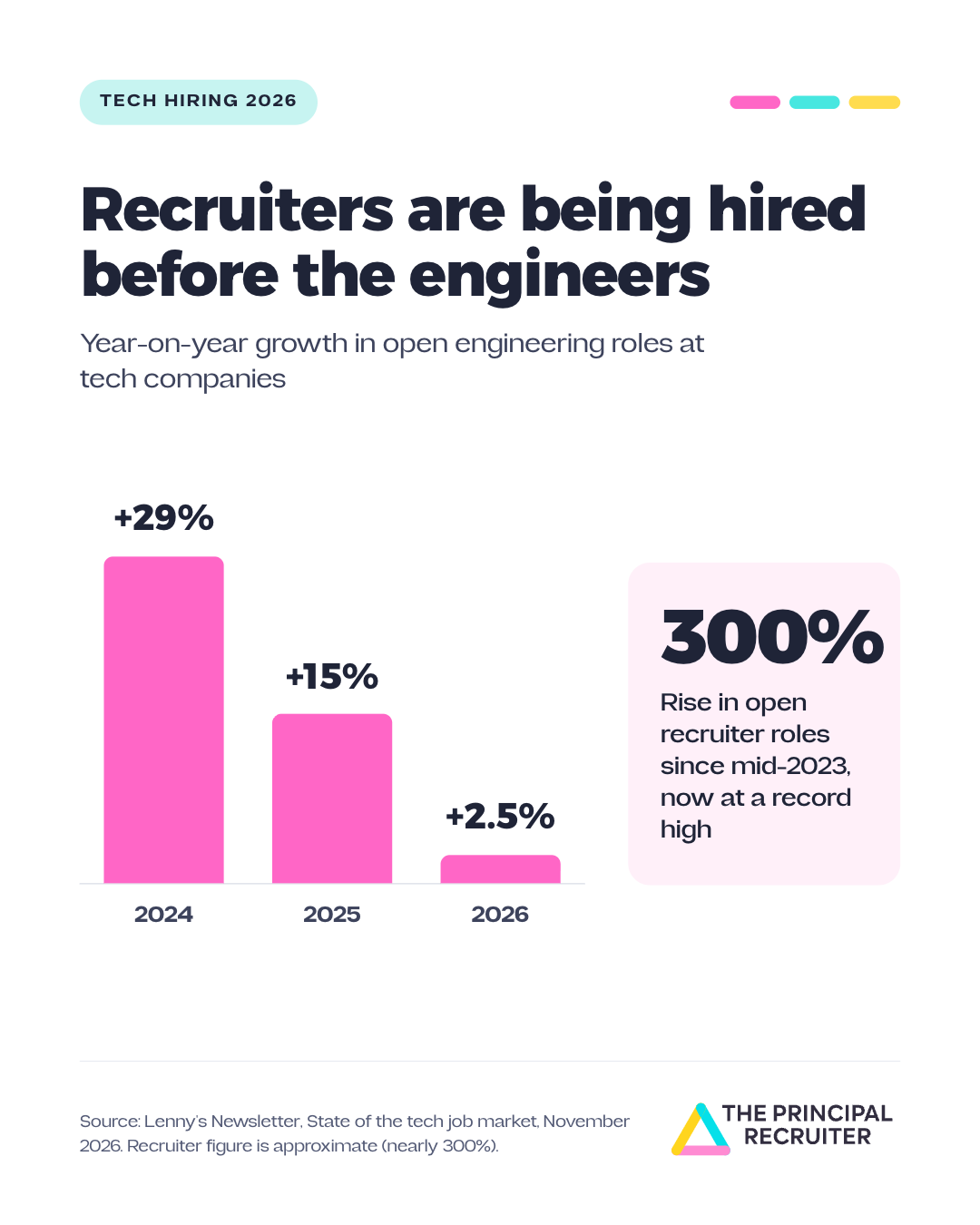
The rise is still worth paying attention to though. I think. In October 2026, tech companies in TrueUp's tracker had an average of 2,715 recruiting vacancies, almost 4 times the low of June 2023. In Lenny's analysis, open recruiter roles are up nearly 300% since mid-2023 and at record highs, which he reads as a possible early sign that engineering hiring will pick up again.
Sources: Lenny's Newsletter
TL;DR
Tech recruiter vacancies averaged 2,715 in October 2026 in TrueUp's tracker, almost 4 times the June 2023 low. More than half of them are in the US.
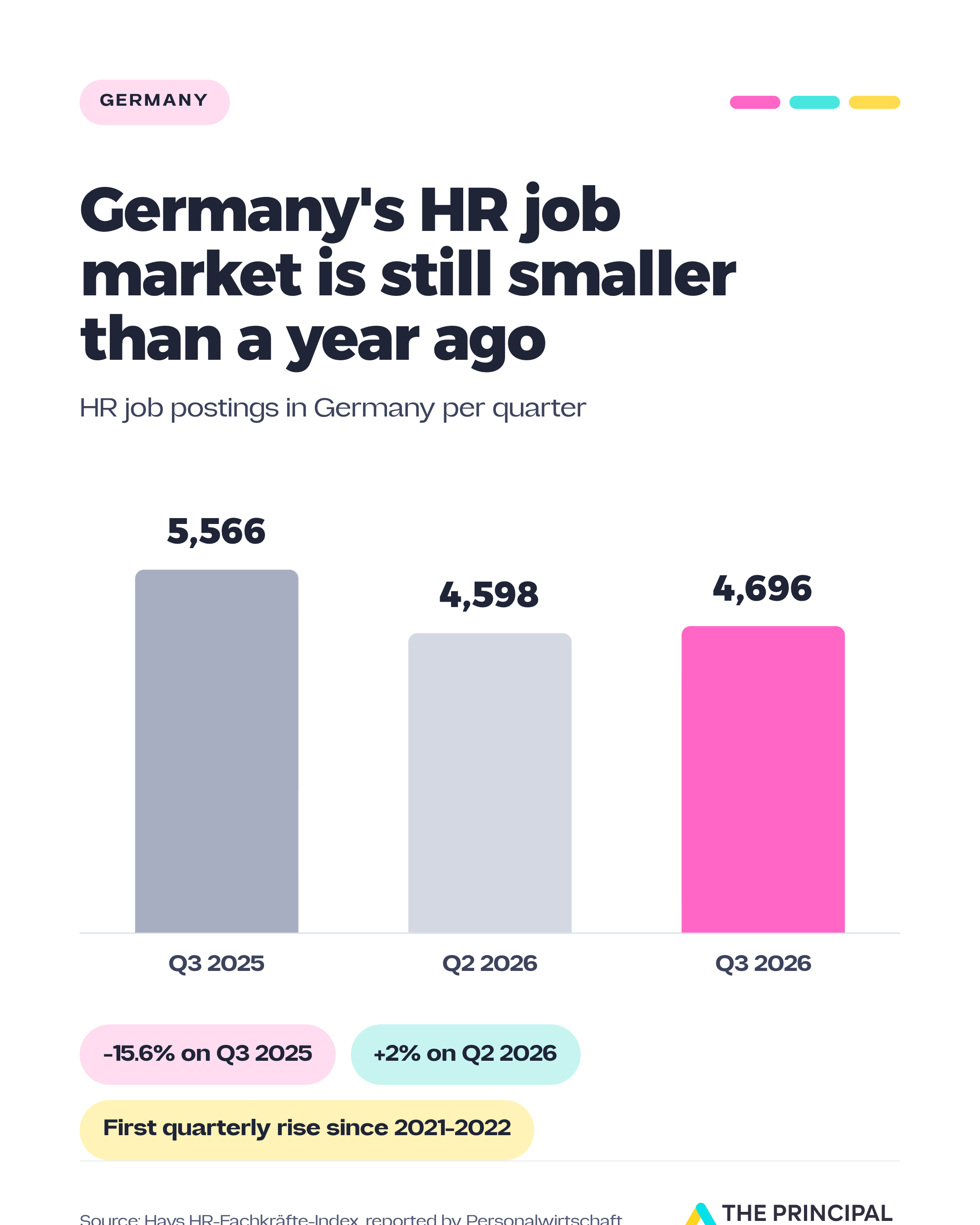
In Europe, the demand is concentrated in a small group of well-funded AI companies such as Parloa, Mistral AI, n8n, etc. while German HR job ads were 15.6% lower than a year earlier.
The last cycle followed the same pattern: companies hired on a growth assumption, then cut their recruiting teams when the assumption changed.
The practical lesson is a blended recruiting team, with a permanent core and contract capacity for peaks, plus a named owner for workforce decisions.
Why did tech companies lay off recruiters in 2022 and 2023?
On 4 May 2022, Klarna announced a new development centre and its intention to hire another 500 employees. 1
9 days later, its chief executive recorded a video for staff announcing that Klarna was laying off 10% of staff, about 700 people. In it, he explained that the business plans set in the autumn had been made in a very different world. The next day, Berlin's Gorillas, the grocery delivery company that had raised nearly $1 billion only 7 months earlier, cut around 300 people, mainly in its Berlin HQ, and many of them had only joined in the previous 6 months. Inside the Layoffs at Klarna
Neither company was careless (in isolation).
When lockdown hit, the first response across tech was to stop hiring. Then offices and shops stayed closed, and companies needed to serve customers online and equip employees to work from home. Germany felt the surge: by April 2022, LinkedIn had nearly 6 times as many German recruiting ads as in January 2019.
At Meta, Mark Zuckerberg later told staff he had invested on the assumption that the jump in online spending would last.
By March 2023, Zuckerberg was writing a different memo. Meta would hire fewer people, so it would cut its recruiting team further. Alphabet followed in September with hundreds of cuts in its global recruiting team. The growth assumption had changed, and the people hired to deliver it were looking for work at the same time.
How did tech sales hiring recover in Europe in 2024?
In April 2024, the French software company Pigment announced a funding round and named a new global head of sales and a head of EMEA.
It had already opened offices in New York and Toronto. After years of building, companies like Pigment were putting people in place to win customers in new markets. Atomico found a wider revival in European venture-backed tech, with job ads up 25% in the first half of 2024 compared with the previous 6 months.
The commercial shift showed up in the kinds of jobs companies were filling. At startups tracked by Carta, most of them in the US, sales made up nearly 1 in 5 hires in 2024, up from around 1 in 7 in 2020. Account executive roles, the people who close deals, edged up, while sales development roles, the people who find and qualify leads, fell.
Germany's wider sales market was more uneven: FIEGE tracked another drop in new sales ads on company career sites at the end of 2024. The public data doesn't tell us how many companies hired extra recruiters specifically to build those sales teams.
What happened to recruiter jobs in Germany in 2025?
At the end of 2025, Hays had 241 fewer recruitment consultants in Germany than a year earlier. Hays is the firm many of us in Germany know for placing recruiters. PageGroup reported 402 fewer staff in fee-earning roles, with most of the reductions in Europe and the UK. The people whose job was filling other people's jobs were among the first to feel the slowdown.
The rest of the market didn't move in one direction.
Salesjob counted more German sales ads in the first 5 months of 2025 than a year earlier, with over 7,000 IT sales openings in May alone. By the end of the year, though, Hays was seeing almost half as many German HR adverts as in the same quarter of 2024. So a German employer looking for someone to sell a technical product faced a very different market from a recruiter looking for their next job.
Inside tech companies, the picture was mixed. Amazon's October filing in Washington state listed recruiters among the affected jobs, while TrueUp's count of global tech recruiting vacancies kept rising. The scale of in-house recruiter layoffs across Europe is still unclear.
Why are AI companies in Europe hiring tech recruiters again in 2026?
In January 2026, Parloa, a Berlin company that builds AI agents for customer service, raised $350 million. It said it would grow its workforce to about 600 employees by the end of 2026, up from around 380, with hiring focused both on developers and sales staff, and new offices in San Francisco and Madrid. Someone has to find those 220 people, across 4 countries, within 12 months, while the product is still changing. That is where this year's recruiter demand comes from. Yahoo Finance
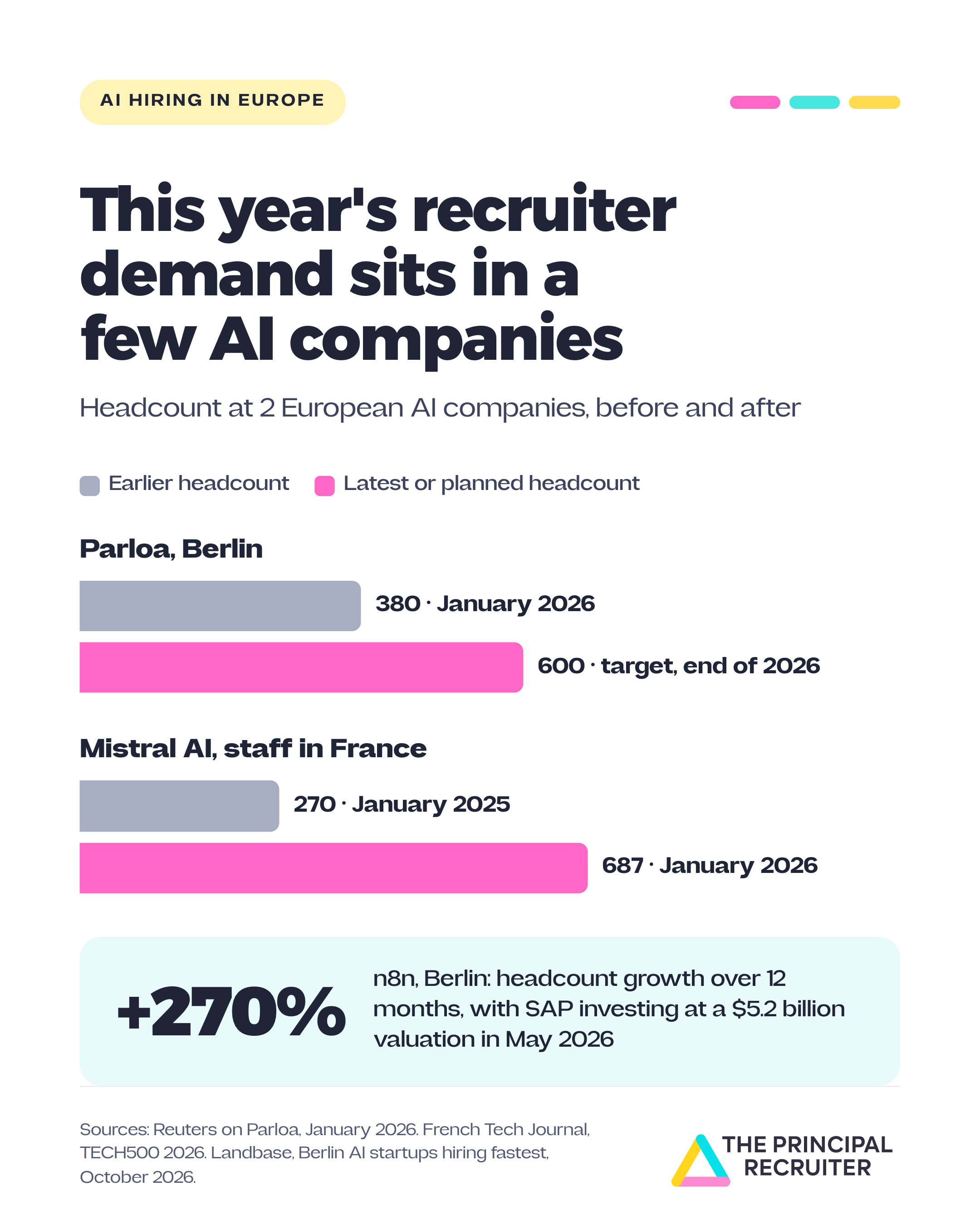
Mistral AI shows the same pattern in France. Between January 2025 and January 2026, it added 417 people in France, growing from 270 to 687 employees, more than any other company in the TECH500 ranking. This autumn it advertised for 2 recruiters in Paris and London. One would partner with hiring managers across Product, Engineering and Science. The other would cover Sales, Pre-Sales/Solutions, Partnerships, Customer Success and Revenue Operations, along with corporate teams.
In Berlin, n8n grew its headcount by more than 270% in 12 months, and in May 2026 SAP invested at a $5.2 billion valuation. All 3 companies are hiring the people who build the product and the people who sell it in the same quarter. frances fastest growing startups are hiring again and ai is everywhere
The wider market looks different.
In Germany, Hays counted 4,696 HR job postings in Q3 2026, against 5,566 in Q3 2025. When Bitkom surveyed 102 German tech startups this summer, one in four said it had put new hires on hold because of AI.
The recruiter jobs are real, but they sit in a small group of well-funded AI companies, and that group is where the risk sits if growth slows. personalwirtschaft.de
I expect the next engineering hires to come mostly from teams building and running AI products, and so far the numbers point to a slower cycle than lockdown. Open engineering roles at tech companies rose only 2.5% over the past year, down from 15% in 2025 and 29% in 2024, while recruiter openings reached record highs.
Companies are hiring recruiters before the engineers those recruiters are meant to find.
Before I call this a recovery, I want to see more people starting engineering jobs across a wider set of companies.
Why do companies cut jobs for AI and then rehire?
Klarna appears in this story twice. After its 2022 layoffs, it told the world that AI could do the work of its customer service team. It cut its workforce from around 5,500 to roughly 3,400 and said its OpenAI-powered assistant did the work of 700 agents. Then satisfaction slipped. Klarna went back to recruiting customer service staff to handle more complex cases.
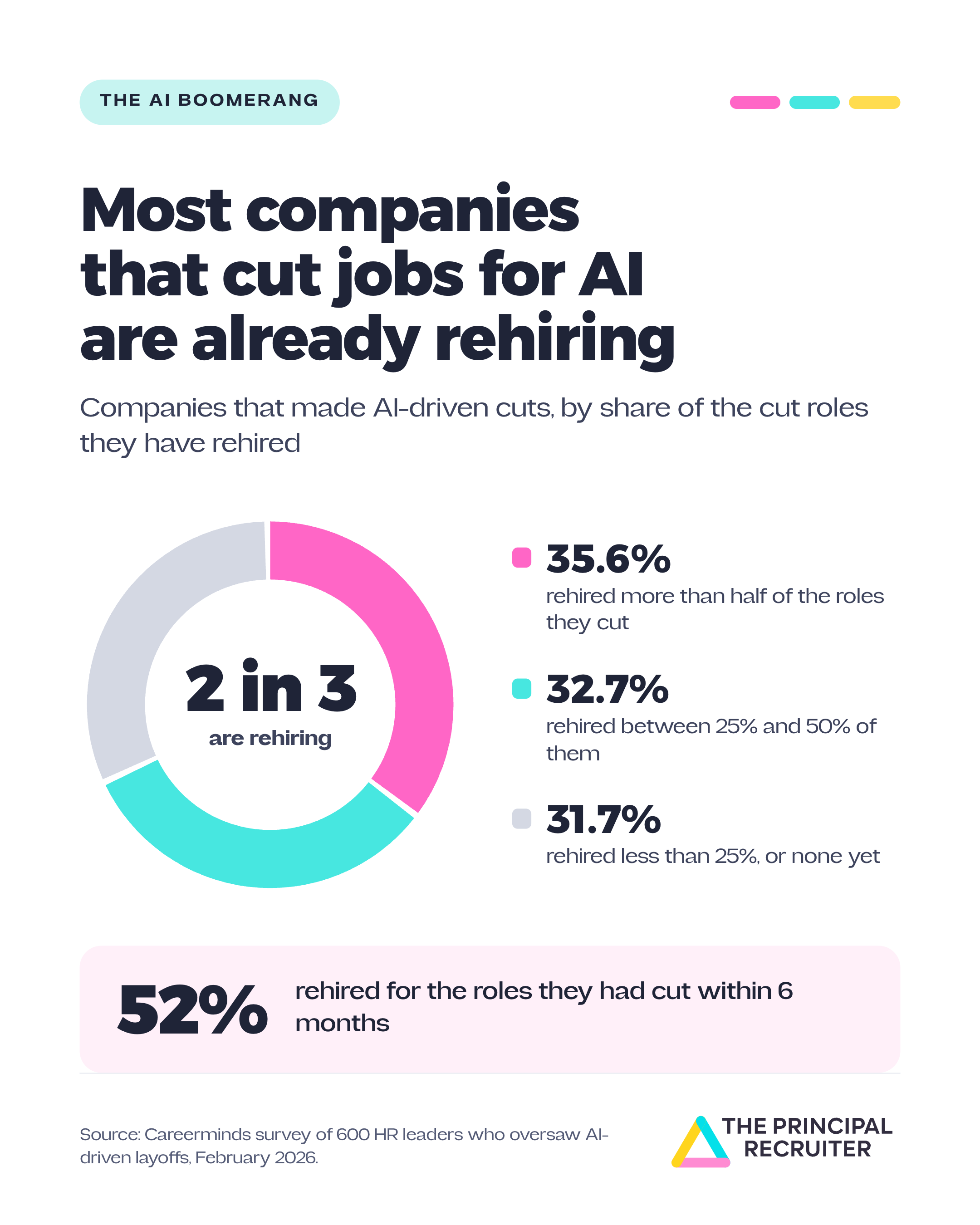
The pattern goes well beyond Klarna. A February 2026 Careerminds survey of 600 HR leaders found that 2 in 3 companies that made AI-driven cuts were already bringing staff back, and 52% did so within 6 months. Germany is heading towards the same decision. In June 2026, the ifo Institute found that around 1 in 2 companies in Germany now consider job cuts from AI possible. In a Bitkom survey of employees, 22% said their employer had stopped refilling positions because of AI, or was already cutting them. 55% of Companies That Slashed Jobs for AI Now Regret It After Restaffing Costs Soar
The tools arrived faster than the decisions.
In a 2025 survey of HR professionals in Germany, around 9 in 10 used AI to write job ads. In the CIPD's 2026 survey, only around a third of HR leaders felt confident estimating how AI would change their workforce needs. A job ad has one owner and takes minutes.
Deciding which work AI takes over, which work it creates and who checks the result needs Finance, the business and HR at the same table, and that conversation takes longer than any tool rollout. The regulation buys us some time for it, though not much.
The EU's Digital Omnibus pushed the AI Act's high-risk rules for CV sorting, candidate screening and performance monitoring from 2 August 2026 to 2 December 2027, while the Article 50 transparency obligations still apply from 2 August 2026.
If the dashboard only counts jobs filled, a hiring freeze makes a recruiting team look idle, and that number makes the team easy to cut. Then the next round of hiring starts, and the people who knew what went wrong last time are gone.
How should talent teams plan recruiting capacity for AI hiring in 2026?
In July 2026, n8n posted 1 or 2 handfuls of new jobs. In August it posted 60, and in September 89, with sales (26 open roles), engineering (24) and HR (6) at the top, according to the job tracker jobspipe. A recruiting team sized for July can't absorb September, and a team hired for September will be too big the next time the plan changes. A blended team is built to handle both.
Say a team has funding for 30 hires next quarter and a product launch might add 30 more. Before recruiting for the extra work, I'd get Finance, the business and Talent Acquisition to agree what would trigger the extra hires and how long the work is likely to last. Then I'd split the capacity 3 ways:
Give the permanent team work it still owns through a slowdown: mapping hard-to-find skills, helping employees move internally, and training hiring managers to run better interviews.
Bring in interim or contract recruiters for a defined peak, with time, pay and handover agreed up front. Add permanent headcount once the work and the funding are sustained.
Give recruiters time to test AI on 1 live hiring process, and measure the whole process, including the time spent checking the tool's output. A tool that filters or ranks candidates falls under the AI Act's high-risk rules from December 2027, so the test is also the moment to write down how the team checks it.
Sources: jobspipe on n8n hiring
What should talent leaders ask before opening the next role?
Klarna announced 500 new hires 19 days before it cut 700 jobs, and a few years later it was rehiring the customer service staff it had replaced with AI. Most of us have worked somewhere with a smaller version of that story. This year's AI hiring rests on growth assumptions too. The difference this time can be a plan that answers 2 questions before the next role opens: if the hiring plan is cut in half, what work will this person still own, and who makes that call?

Founder of The Principal Recruiter. 16+ years in talent acquisition. Building stronger hiring systems worldwide.