The TA Automation Map: Sourcing Tools for Recruiters in 2026 (Part 3)
A practical guide to AI sourcing tools, EU compliance risks, and DIY workflows recruiters can build with Claude, Gemini, and free automation tools. Part 3 of the TA Automation Map series
This is Part 3 of my series mapping AI and automation across the recruitment funnel. Part 1 was the introduction. Part 2 covered application review and screening. Now we're at sourcing.
Sourcing sits between intake (you know what you're looking for) and screening (you're evaluating what came in). It's the work of finding people. Going out and identifying candidates who might be right for a role, getting their attention, and getting them into the pipeline.
For most recruiters, sourcing means LinkedIn. For many teams, it means LinkedIn and nothing else. I want to change that in this article. I'll cover the AI tools that exist, what they cost, where they create legal risk in Europe, and, the part I care about most, what you can build yourself with tools you probably already have.
The tools
The AI sourcing market in 2026 has a lot of options. I mapped the ones I think are worth knowing about and organized them by accessibility, cheapest and most practical first. I have no affiliation with these brands and no commission is paid for me to share their names, nor have I used all these tools in depth. Some of the knowledge is what I gather from my Talent Crunch - Berlin community.
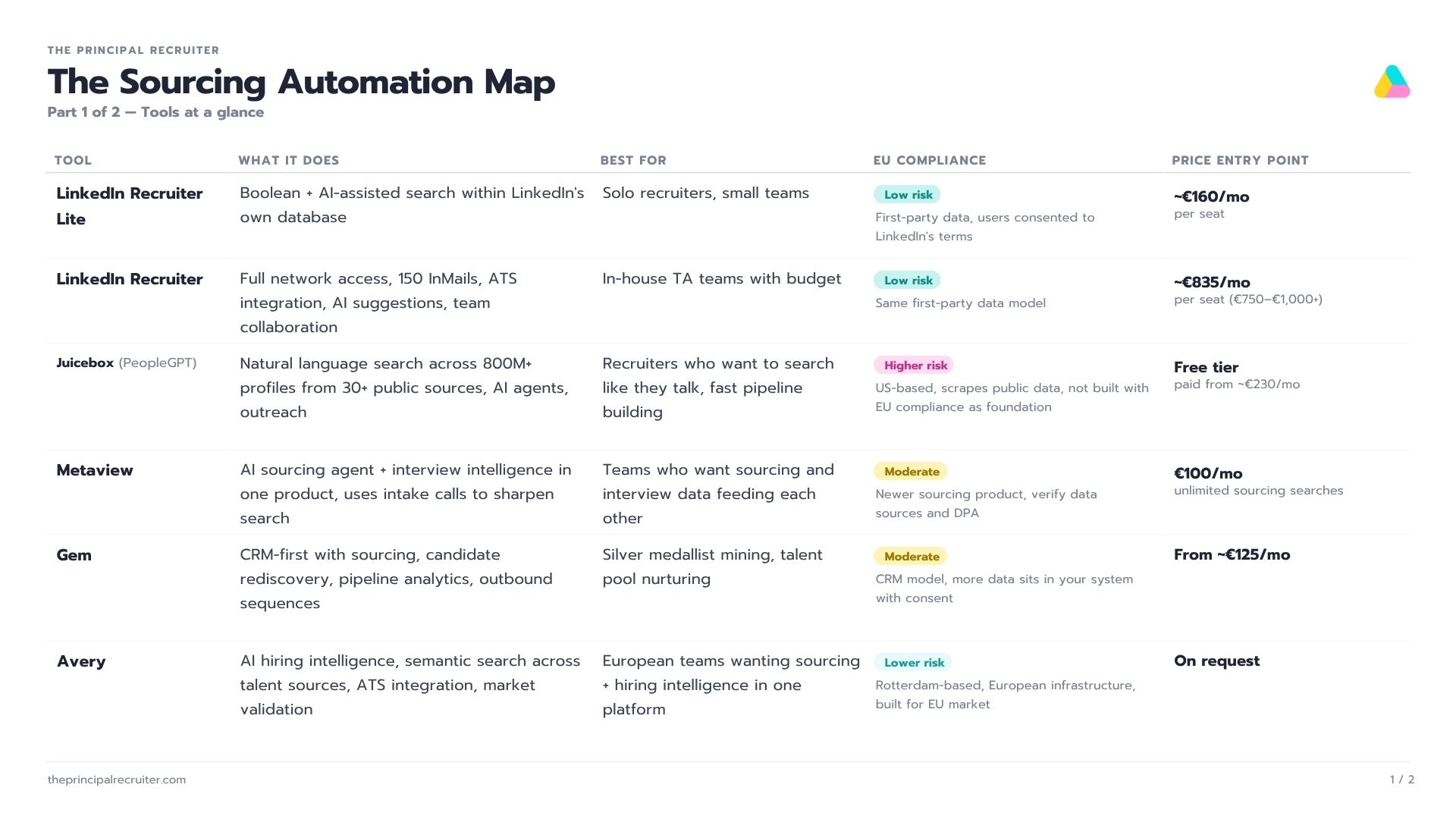
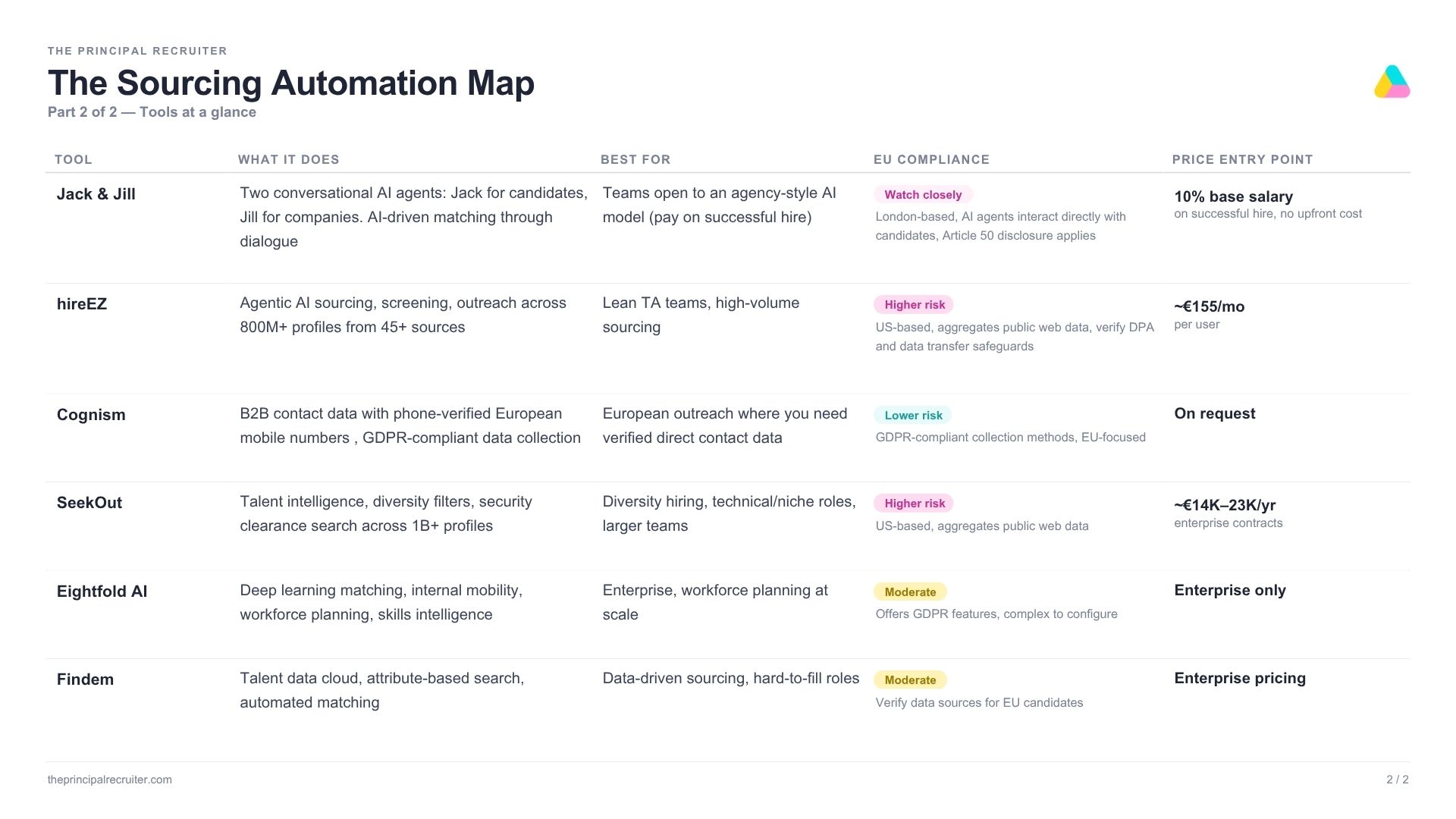
A few things worth noting:
Most of these tools do the same core thing: aggregate public profiles, match them with AI, and enable outreach. The differences are in data depth, outreach automation, CRM capability, and where the data lives.
Jack & Jill is a different category. You're not operating a tool. You're hiring an AI-powered agency that charges on results. For a small team without sourcing budget for tooling, that model removes upfront cost. The trade-off: you hand over candidate communication to an AI agent. I'll come back to why that matters legally.
Metaview started an interview intelligence tool. They now have a full AI sourcing agent that pulls context from your intake calls and past interviews to sharpen who it looks for. At €100/month for unlimited searches, it's one of the most accessible dedicated sourcing tools on this list.
Before you buy any of these, ask yourself one question: do I need a new database of candidates, or do I need to get more out of the candidates I already have?
EU compliance: 3 things you need to know
I'm not going to write a legal textbook here. I covered GDPR and the EU AI Act in more depth in Part 2. For sourcing, three things to watch out for
1. Publicly available does not mean you can use it freely
In December 2024, France's data protection authority (CNIL) fined KASPR €240,000. KASPR sells a Chrome extension that scrapes professional contact details from LinkedIn profiles. Their database held around 160 million contacts. The CNIL found they collected data even from users who had restricted the visibility of their profiles, held it for up to five years, didn't inform people their data was being collected until 2022 (four years after launch), and when asked where they got someone's data, answered vaguely with "publicly accessible sources."
Every AI sourcing tool that builds its database by aggregating public profile data operates on the same principle KASPR got fined for. The legal basis they claim is legitimate interest under GDPR Article 6(1)(f). That claim is getting tested, and so far the regulators are not impressed.
For you as a recruiter, the risk sits with your company. The company is the data controller. The tool vendor's claim to be GDPR compliant does not transfer the legal responsibility off your desk. Before you sign up, check: where is the data stored? What's the vendor's legal basis? Can they give you a Data Processing Agreement? Can candidates opt out and get deleted?
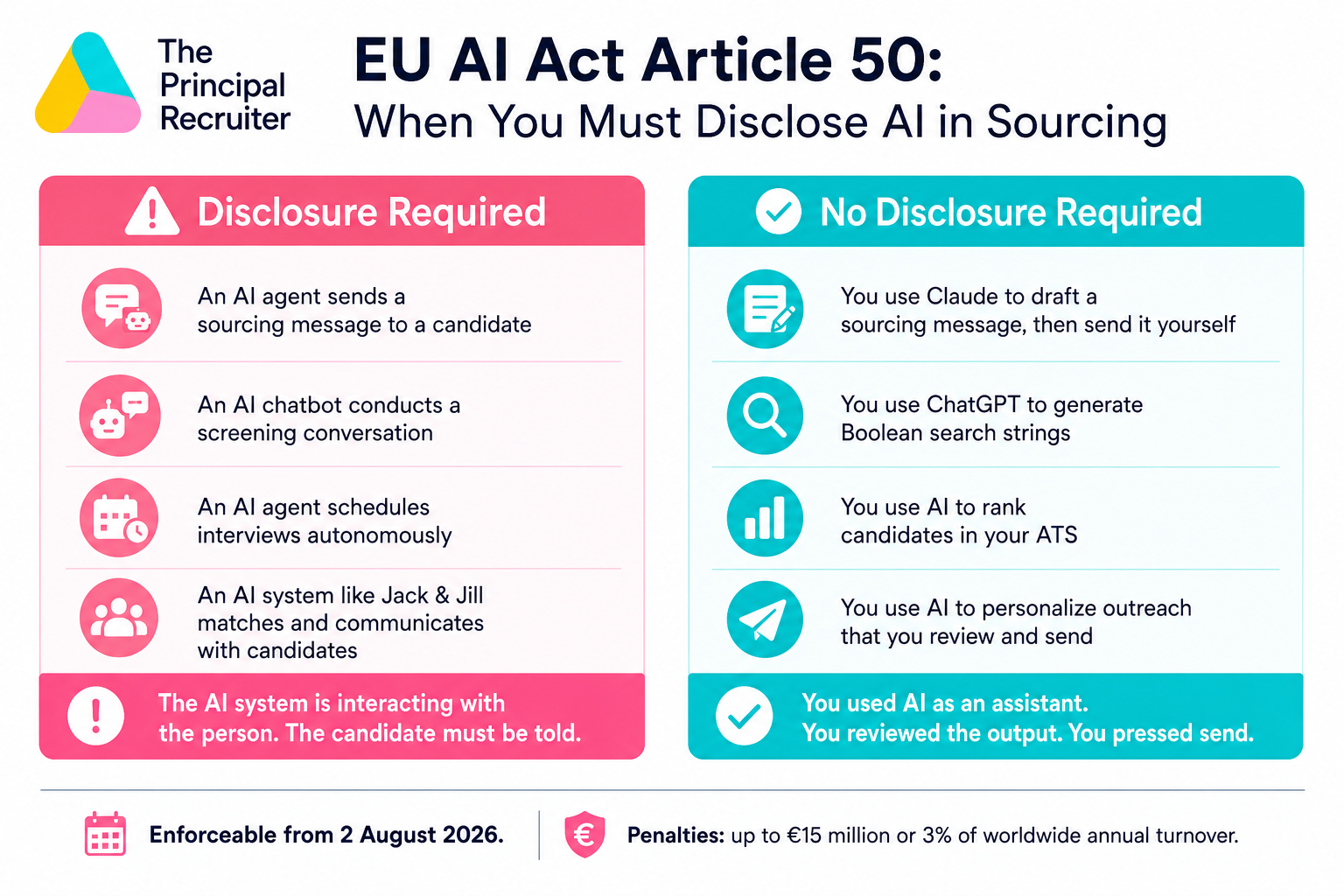
2. From August 2026, if an AI agent contacts a candidate, the candidate must know it's AI
EU AI Act Article 50 requires that people are informed when they're interacting with an AI system.
The European Commission published draft guidelines in May 2026 that extend this to agentic AI: if a provider cannot reliably determine whether the agent will interact with a person, the agent must disclose itself as AI in every situation where that interaction is plausible.
This catches Juicebox Agents, hireEZ's EZ Agent, Jack & Jill (both Jack and Jill are AI agents), Workable Agent, and any other tool that autonomously messages candidates. Penalties reach up to €15 million or 3% of worldwide annual turnover.
One important distinction: this obligation triggers when the AI system is the one interacting with the person. If you use Claude to help you draft a sourcing message and then you send it yourself, that's different. You wrote it with AI assistance. You reviewed it. You pressed send. Article 50 does not require disclosure for that.
3. Recruitment AI is classified as high-risk under the EU AI Act
Heavier obligations (conformity assessments, bias testing, documentation) are coming, with the enforcement date pushed to 2 December 2027 by the AI Omnibus agreement. Worth tracking, not worth panicking about yet.
Build it yourself
This is the part I care about most, and the part I think most sourcing guides sometimes skip. You can build real sourcing capability with tools you already have or can get on a free plan. Five workflows.
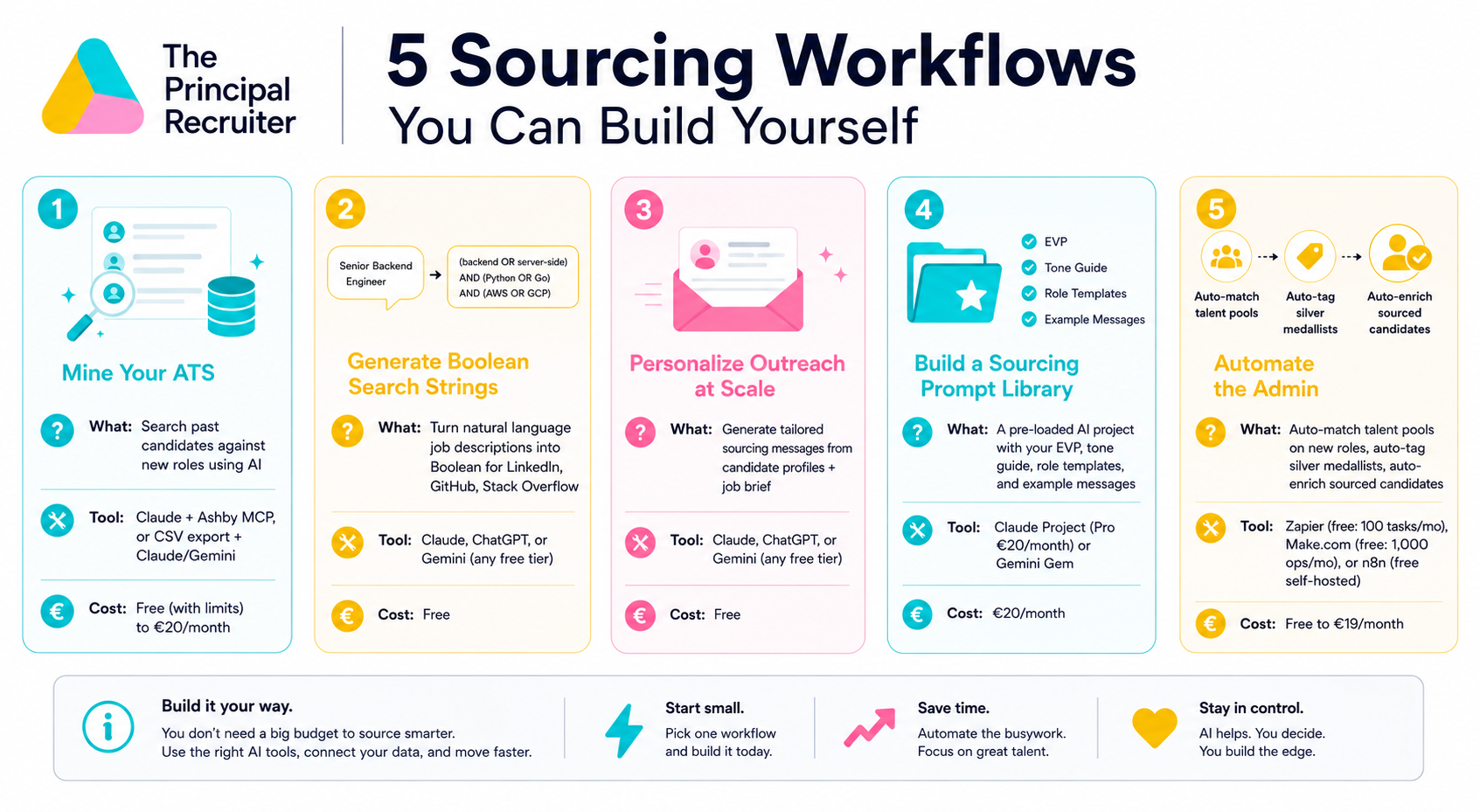
1. Mine your ATS with Claude + Ashby MCP
The simplest sourcing move - look at the candidates you already have
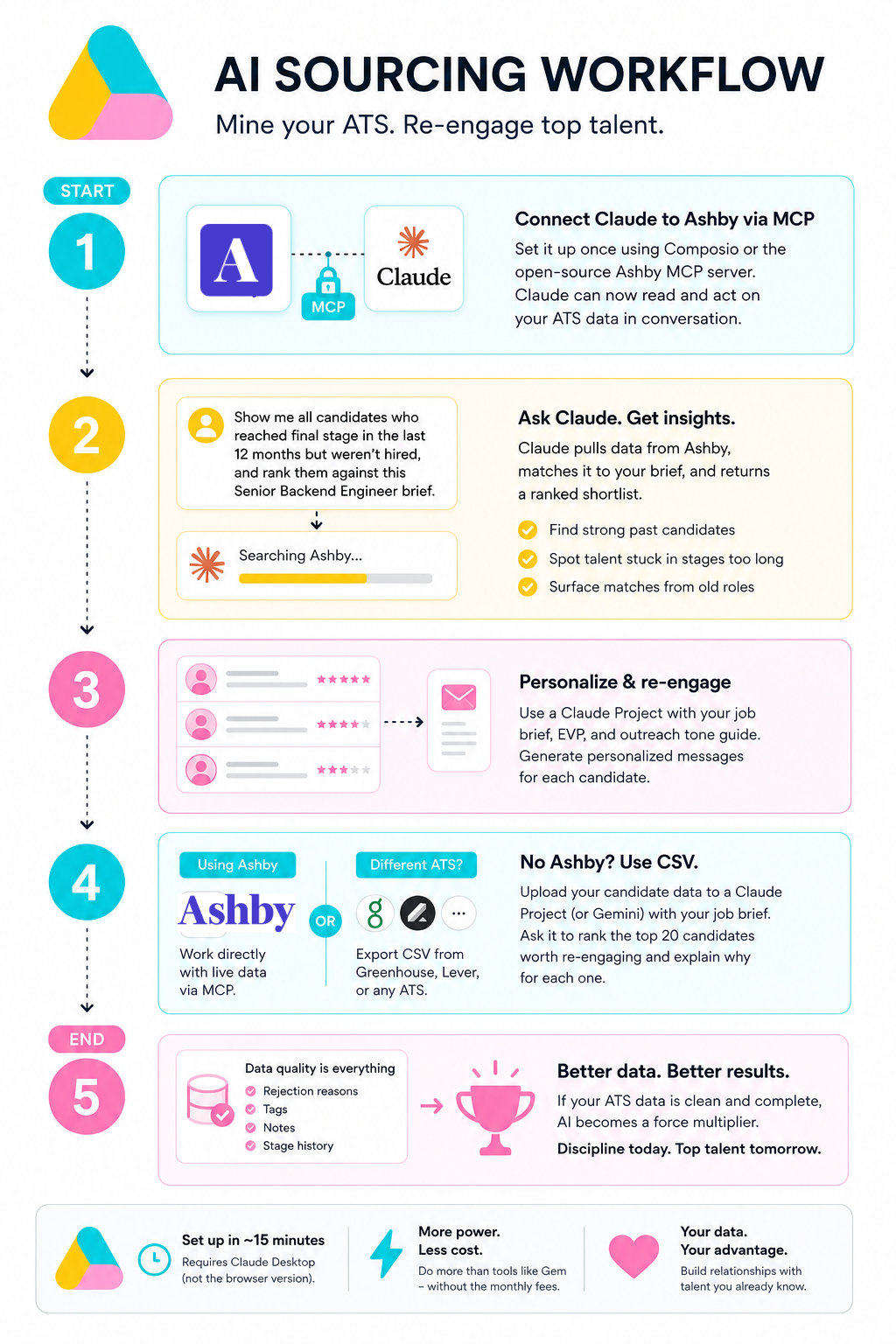
If you use Ashby, you can now connect it directly to Claude through MCP (Model Context Protocol). MCP lets Claude read and act on your ATS data in conversation. You set it up once through a provider like Composio or the open-source Ashby MCP server, and from then on you can talk to your ATS through Claude.
What that looks like: you open Claude Desktop and type something like "Show me all candidates who reached final stage interviews in the last 12 months but weren't hired, and rank them against this new Senior Backend Engineer brief." Claude pulls the data from Ashby, matches it against your criteria, and gives you a ranked shortlist.
You can also ask Claude to find candidates in your pipeline who've been sitting in a stage too long, or surface people from old roles who match a new brief. Combine this with a Claude Project that holds your job brief, your EVP, and your outreach tone guide, and you can generate personalized re-engagement messages for each candidate Claude finds.
The setup takes about 15 minutes with a guide. It may require Claude Desktop (not the browser version). And it's more than most recruiters will do without someone walking them through it the first time. But once it's running, you have functionality that overlaps with what Gem charges hundreds of euros per month for.
If you don't use Ashby, the same logic applies with a CSV export. Export your candidate database from Greenhouse, Lever, or whatever ATS you use. Upload it to a Claude Project or Google Gemini along with your job brief. Ask it to rank the top 20 candidates worth re-engaging and explain why for each one.
The honest blocker here is data quality. If your ATS has no rejection reasons, no tags, no notes on past candidates, the AI has nothing useful to work with. That's a discipline problem, not a tool problem. And it's worth fixing regardless of whether you ever use AI for sourcing.
2. AI-generated Boolean and search strings
Some recruiters still can't write proper Boolean. I don't think that's a failure, I think Boolean is an unintuitive syntax that recruiters shouldn't have to learn from scratch in 2026. Claude, ChatGPT, and Gemini can all generate complex search strings from a natural language description.
Try this very basic approach to begin with: open any AI tool (free tier works fine) and type "I need a senior backend engineer in Berlin with payments experience who has worked in a startup environment and ideally has exposure to system migrations. Generate Boolean search strings for LinkedIn Recruiter, GitHub, and Stack Overflow"
You'll get usable search strings in seconds. You can then iterate: "Make it broader, I'm getting too few results" or "Add a filter for people who've been in their current role for 2+ years."
This costs nothing. It works on any free AI tool. And it replaces a skill gap that blocks a lot of recruiters from doing effective sourcing outside of simple keyword searches.
3. AI-assisted outreach personalisation
Take a candidate's public LinkedIn profile summary. Paste it into Claude or ChatGPT (or upload the PDF which you can download from LinkedIn) along with your job brief and a note on your outreach tone. Ask for a personalised sourcing message that references specific things from their background.
The difference between a generic sourcing message and one that references a candidate's specific project, tech stack, or career move is the difference between a 5% and a 25% response rate. AI makes this possible at scale without templating yourself into sounding like a bot.
And remember the compliance line from Section 2: you drafted this with AI. You reviewed it. You sent it. Article 50 does not apply here. This is materially different from an AI agent sending the message autonomously.
4. Build a sourcing prompt library in a Claude Project or Gemini Gem
Create a Claude Project (Claude Pro at €20/month, or Claude Team if you're processing candidate data professionally, because Claude Free and Pro are consumer products without a Data Processing Agreement). Load it with your company EVP, your role brief template, your outreach tone guide, and a few examples of messages that got replies.
Now every sourcing message, Boolean string, or candidate brief you generate is pre-calibrated to your company. You're not starting from zero each time. The AI already knows your voice, your standards, and what good looks like.
I built something similar for a client's screening workflow (a Gemini Gem for generating screening prompts in Ashby) and it became the quality standard for the team. The same approach works for sourcing.
5. Simple automation with Zapier, Make.com, or n8n
For the recruiter who wants to go one step further, here are 3 examples of what you can automate:
A new role opens in your ATS. An automation searches your talent pool and notifies you of potential matches. You start sourcing with warm leads on day one instead of day five.
A candidate gets rejected at final stage. An automation adds them to a silver medallist talent pool and sets a 6-month re-engagement reminder. You stop losing good candidates to a manual process that nobody maintains.
A new candidate gets sourced. An automation enriches their profile with publicly available data and creates the record in your ATS. You cut 5 minutes of admin per candidate.
What these cost you on free plans:
Zapier: the easiest to set up, 8,000+ integrations. Free plan gives you 100 tasks per month. That's enough to test a workflow. Paid starts at around €19/month.
Make.com: visual builder, better for complex logic, cheaper at scale. Free plan gives you 1,000 operations per month. Paid starts at around €9/month.
n8n: open source, self-hosted option, full control over your data. Free cloud plan available. If you self-host, it's free entirely. More technical to set up, but the recruiting community on YouTube and Reddit has templates you can copy.
None of these require coding. All three have drag-and-drop interfaces. The learning curve is real but manageable over a weekend.
Compliance checklist for sourcing
If someone asked you tomorrow to prove your sourcing practices are compliant, here is what you'd need:
A documented legal basis for processing candidate data (likely legitimate interest with a completed balancing test).
Evidence that candidates can find out you hold their data and where you got it from (transparency).
A data retention policy: you're not hoarding profiles for years with no plan to use them (the KASPR retention problem).
If you use a third-party sourcing tool: a signed Data Processing Agreement, confirmed data storage location, a working candidate opt-out mechanism.
If you use AI agents for outreach: Article 50 disclosure in place by August 2026.
If you process candidate data through AI tools: a compliant tier. Claude Free and Claude Pro are consumer products without a DPA. Claude Team or the API is the minimum compliant tier for professional use. Same logic applies to ChatGPT (you need the business tier, not the personal one).
What's next
Part 4 will cover intake meetings and how AI can make the handoff between hiring manager and recruiter faster and more structured. That's where sourcing quality gets decided before a single candidate gets contacted.

Founder of The Principal Recruiter. 16+ years in talent acquisition. Building stronger hiring systems worldwide.